


MCIA-Level-1 Actual Questions Answers PDF 100% Cover Real Exam Questions
MCIA-Level-1 Exam questions and answers
Topics of MuleSoft mcia - Level 1: MuleSoft Certified Integration Architect - Level 1 Exam
Candidates must know the exam topics before they start preparation because it will help them in hitting the core. Our mcia-level-1 practice exams will include the topics discussed in detail:
Configuring Anypoint Platform
- Identify common and distinguishing features and usage scenarios for CloudHub VPCs and public worker cloud.
- Select Anypoint Platform identity management vs client management for the correct purpose.
- Configure business groups, roles, and permissions within an Anypoint Platform organization.
- Define a performant and HA deployment architecture for Mule applications in on-prem deployments.
- Select monitoring options for all available Anypoint Platform deployment options.
- Suggest the number of Mule runtimes needed for a Mule application given performance targets and HA requirements.
Selection Integration Styles
- When designing an integration solution, select the most appropriate interface/data technology and interface definition language for all integration interfaces.
- Given a description of an integration problem, identify the most appropriate integration style.
- Recognize scenarios where message correlation is necessary.
- Design parts of an integration solution using general message-based integration or event-driven architecture (EDA) using message brokers or streaming technologies.
Operating and Monitoring Integration Solutions
- Identify metrics and operations exposed by default via JMX.
- Specify the type of metrics for API invocations and API implementations that can be monitored with Anypoint Platform.
- Identify ways of transmitting IDs between components in remote interactions and capture this in the interface design of the remote interaction.
- Identify differences in monitoring and alerting between customer-hosted and MuleSoft-hosted Anypoint Platform.
DevOps
- Specify the purpose of various MuleSoft products in DevOps and CI/CD.
- Identify differences, advantages, and disadvantages of DevOps based on deployable Mule applications versus container images.
- Specify testing strategies that use both mocking and invoking of external dependencies.
- Formulate an effective source code management strategy including branching and merging.
Handling Events
- Use the streaming to handle large payloads within Mule applications.
- Predict the runtime load-balancing behavior of messages sent to the public URL of a Mule application deployed to multiple CloudHub workers.
- Predict the runtime behavior of messages queued internally for processing for load balancing or to achieve reliability.
- Use Mule 4 constructs to make effective use of Enterprise Integration Patterns.
- Identify scenarios in which to use different storage mechanisms including persistent and non-persistent ObjectStore, in-memory ObjectStore, cluster-replicated in-memory OS, hash tables, and disk-persisted OS.
- Select suitable storage mechanisms for IDs (correlation IDs, message IDs, transaction IDs) in Mule applications deployed to CloudHub or on-premises.
Designing Applications
- Identify possible failures when a component (such as an API client) invokes a remote component (such as an API implementation).
- For a given Mule 4 connector (Premium, Select, and MuleSoft Certified), identify its purpose, the network protocol it uses, and whether it supports incoming or outgoing types of connections.
- Specify when a Mule application would require persistence and select an appropriate persistence solution.
- Specify the requirements that would require the use of domain-level connectors.
Designing Networks
- When incoming and outgoing HTTPS connections with mutual authentication are used, identify what certificates are needed in what stores in a different environment.
- Match protocols with networking constraints and API layers.
- For a given connector, recognize whether it will typically connect to/from an external -system across organizational boundaries.
- Use transport protocols and connectors correctly and coherently when and where applicable.
NEW QUESTION 15
An organization is sizing an Anypoint VPC to extend their internal network to Cloudhub.
For this sizing calculation, the organization assumes 150 Mule applications will be deployed among three(3) production environments and will use Cloudhub's default zero-downtime feature. Each Mule application is expected to be configured with two(2) Cloudhub workers.This is expected to result in several Mule application deployments per hour.
- A. 10.0.0.0/23(512 IPs)
- B. 10.0.0.0/21(2048 IPs)
- C. 10.0.0.0/22(1024IPs)
- D. 10.0.0.0/24(256 IPs)
Answer: B
NEW QUESTION 16
Mule application A receives a request Anypoint MQ message REQU with a payload containing a variable-length list of request objects. Application A uses the For Each scope to split the list into individual objects and sends each object as a message to an Anypoint MQ queue.
Service S listens on that queue, processes each message independently of all other messages, and sends a response message to a response queue.
Application A listens on that response queue and must in turn create and publish a response Anypoint MQ message RESP with a payload containing the list of responses sent by service S in the same order as the request objects originally sent in REQU.
Assume successful response messages are returned by service S for all request messages.
What is required so that application A can ensure that the length and order of the list of objects in RESP and REQU match, while at the same time maximizing message throughput?
- A. Perform all communication involving service S synchronously from within the For Each scope, so objects in RESP are in the exact same order as request objects in REQU
- B. Keep track of the list length and all object indices in REQU, both in the For Each scope and in all communication involving service Use persistent storage when creating RESP
- C. Use a Scatter-Gather within the For Each scope to ensure response message order Configure the Scatter-Gather with a persistent object store
- D. Use an Async scope within the For Each scope and collect response messages in a second For Each scope in the order In which they arrive, then send RESP using this list of responses
Answer: B
NEW QUESTION 17
A mule application is deployed to a Single Cloudhub worker and the public URL appears in Runtime Manager as the APP URL.
Requests are sent by external web clients over the public internet to the mule application App url. Each of these requests routed to the HTTPS Listener event source of therunning Mule application.
Later, the DevOps team edits some properties of this running Mule application in Runtime Manager.
Immediately after the new property values are applied in runtime manager, how is the current Mule application deployment affected and how will future web client requests to the Mule application be handled?
- A. CloudHub will redeploy the Mule application to a NEW Cloudhub worker New web client requests will RETURN AN ERROR until the NEW Cloudhub worker is available
- B. Cloudhub will redeploy the Mule application to a NEW Cloudhub worker New webclient requests are ROUTED to the OLD Cloudhub worker until the NEW Cloudhub worker is available.
- C. Cloudhub will redeploy the mule application to the OLD Cloudhub worker New web client requests are ROUTED to the OLD Cloudhub worker BOTH before and afterthe Mule application is redeployed.
- D. Cloudhub will redeploy the Mule application to the OLD Cloudhub worker New web client requests will RETURN AN ERROR until the Mule application is redeployed to the OLD Cloudhub worker
Answer: B
NEW QUESTION 18
An organization has various integrations implemented as Mule applications. Some of these Mule applications are deployed to customhosted Mule runtimes (on-premises) while others execute in theMuleSoft-hosted runtime plane (CloudHub). To perform the Integra functionality, these Mule applications connect to various backend systems, with multiple applications typically needing to access the backend systems.
How can the organization most effectively avoid creating duplicates in each Mule application of the credentials required to access thebackend systems?
- A. Store the credentials in properties files in a shared folder within the organization's data center Have the Mule applications load properties files from this shared location at startup
- B. Configure or create a credentials service that returns the credentials for each backend system, and that is accessible from customer-hosted and MuleSoft-hosted Mule runtimes Have the Mule applications toad the properties at startup by invoking that credentials service
- C. Segregate the credentials for each backend system into environment-specific properties files Package these properties files in each Mule application, from where they are loaded at startup
- D. Create a Mule domain project that maintains the credentials as Mule domain-shared resources Deploy the Mule applications to the Mule domain, so the credentials are available to the Mule applications
Answer: B
NEW QUESTION 19
Refer to the exhibit.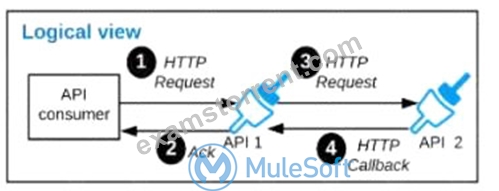
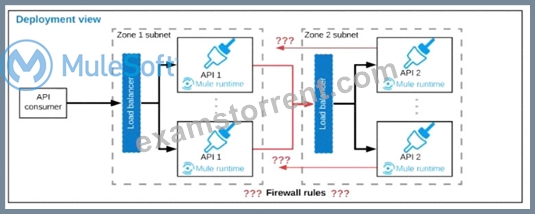
A business process involves two APIs that interact with each other asynchronously over HTTP. Each API is implemented as a Mule application. API 1 receives the initial HTTP request and invokes API 2 (in a fire and forget fashion) while API 2, upon completion of the processing, calls back into API l to notify about completion of the asynchronous process.
Each API Is deployed to multiple redundant Mule runtimes and a separate load balancer, and is deployed to a separate network zone.
In the network architecture, how must the firewall rules be configured to enable the above Interaction between API 1 and API 2?
- A. To authorize the certificates used by both the apis
- B. To allow communication between the load balancers used by each API
- C. To open direct two-way communication between the Mule runtimes of both APIs
- D. To enable communication from each API's Mule runtimes and network zone to the toad balancer of the other API
Answer: D
NEW QUESTION 20
A Mule application is being designed to do the following:
Step 1: Read a SalesOrder message from a JMS queue, where each SalesOrder consists of a header and a list of SalesOrderLineltems.
Step 2: Insert the SalesOrder header and each SalesOrderLineItem into different tables in an RDBMS.
Step 3: Insert the SalesOrder header and the sum of the prices of all its SalesOrderLineltems into a table in a different RDBMS.
No SalesOrder message can be lost and the consistency of all SalesOrder-related information in both RDBMSs must be ensured at all times.
What design choice (including choice of transactions) and order of steps addresses these requirements?
- A. 1. Read the JMS message (NOT in an XA transaction)
2. Perform EACH DB insert in a SEPARATE DB transaction
3. Acknowledge the JMS message - B. 1. Read and acknowledge the JMS message (NOT in an XA transaction)
2. In a NEW XA transaction, perform BOTH DB inserts - C. 1. Read the JMS message in an XA transaction
2. In the SAME XA transaction, perform BOTH DB inserts but do NOT acknowledge the JMS message - D. 1. Read the JMS message (NOT in an XA transaction)
2. Perform BOTH DB inserts in ONE DB transaction
3. Acknowledge the JMS message
Answer: C
Explanation:
Explanation
NEW QUESTION 21
Refer to the exhibit.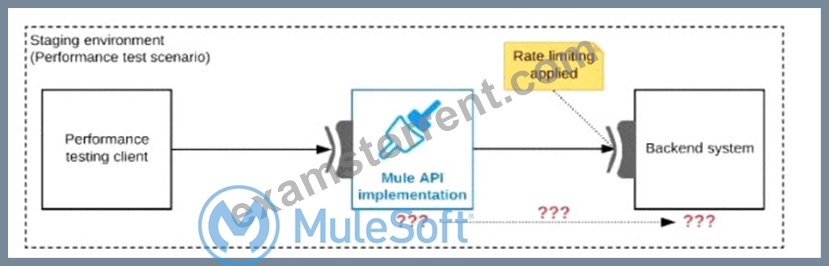
One of the backend systems invoked by an API implementation enforces rate limits on the number of requests a particular client can make. Both the backend system and the API implementation are deployed to several non-production environments in addition to production.
Rate limiting of the backend system applies to all non-production environments. The production environment, however, does NOT have any rate limiting.
What is the most effective approach to conduct performance tests of the API implementation in astaging (non-production) environment?
- A. Conduct scaled-down performance tests in the staging environment againstthe rate limited backend system then upscale performance results to full production scale
- B. Use MUnit to simulate standard responses from the backend system then conduct performance tests to identify other bottlenecks in the system
- C. Create a mocking service that replicates the backend system's production performance characteristics.Then configure the API implementation to use the mocking service and conduct the performance tests
- D. Include logic within the API implementation that bypasses invocations of the backend system in a performance test situation.Instead invoking local stubs that replicate typical backend system responses then conduct performance tests using this API Implementation
Answer: A
NEW QUESTION 22
Refer to the exhibit. An organization deploys multiple Mule applications to the same customer-hosted Mule runtime. Many of these Mule applications must expose an HTTPS endpoint on the same port using a server- side certificate that rotates often.
What is the most effective way to package the HTTP Listener and package or store the server-side certificate when deploying these Mule applications, so the disruption caused by certificate rotation is minimized?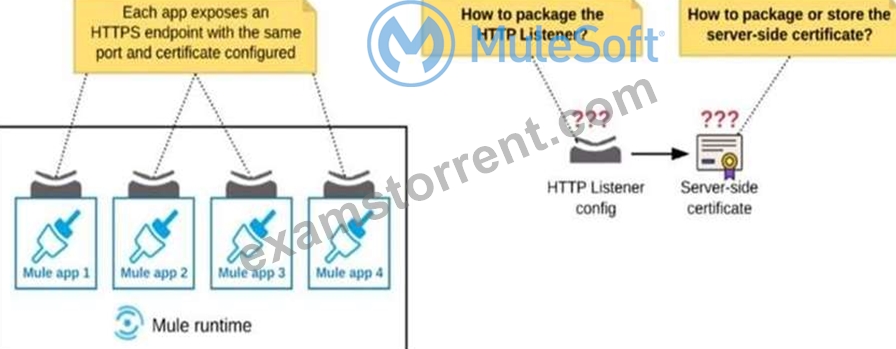
- A. Package an HTTPS Listener configuration in all Mule APPLICATIONS that need to expose an HTTPS endpoint Package the server-side certificate in a NEW Mule DOMAIN project
- B. Package the HTTPS Listener configuration in a Mule DOMAIN project, referencing it from all Mule applications that need to expose an HTTPS endpoint Package the server-side certificate in the SAME Mule DOMAIN project
- C. Package the HTTPS Listener configuration in a Mule DOMAIN project, referencing it from all Mule applications that need to expose an HTTPS endpoint Store the server-side certificate in a shared filesystem location in the Mule runtime's classpath, OUTSIDE the Mule DOMAIN or any Mule APPLICATION
- D. Package the HTTPS Listener configuration in a Mule DOMAIN project, referencing it from all Mule applications that need to expose an HTTPS endpoint Package the server-side certificate in ALL Mule APPLICATIONS that need to expose an HTTPS endpoint
Answer: C
NEW QUESTION 23
Refer to the exhibit.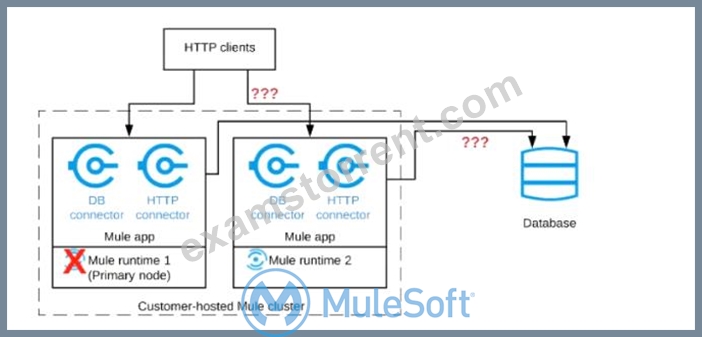
A Mule application is deployed to a cluster of two customer-hosted Mute runtimes. The Mute application has a flow that polls a database and another flow with an HTTP Listener.
HTTP clients send HTTP requests directly to individual cluster nodes.
What happens to database polling and HTTP request handling in the time after the primary (master) node of the cluster has railed, but before that node is restarted?
- A. Database polling stops All HTTP requests continue to be accepted
- B. Database polling stops All HTTP requests are rejected
- C. Database polling continues All HTTP requests continue to be accepted, but requests to the failed node Incur increased latency
- D. Database polling continues Only HTTP requests sent to the remaining node continue to be accepted
Answer: D
NEW QUESTION 24
Refer to the exhibit.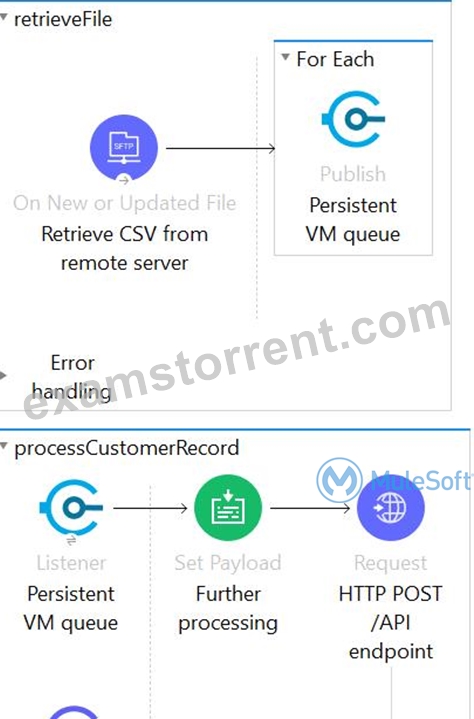
This Mule application is deployed to multiple Cloudhub workers with persistent queue enabled. The retrievefile flow event source reads a CSV file from a remote SFTP server and then publishes each record in the CSV file to a VM queue. The processCustomerRecords flow's VM Listner receives messages from the same VM queue and then processes each message separately.
How are messages routed to the cloudhub workers as messages are received by the VM Listener?
- A. Each message is routed to the SAME Cloudhub worker that retrieved the file, thereby BINDING ALL messages to ONLY that ONE Cloudhub worker
- B. Each message is routed to ONE of the Cloudhub workers in a DETERMINSTIC round robin fashion thereby EXACTLY BALANCING messages among the cloudhub workers
- C. Each messages routes to ONE of the available Clouhub workers in a NON- DETERMINSTIC non round-robin fashion thereby APPROXIMATELY BALANCING messages among the cloudhub workers
- D. Each message is duplicated to ALL of the Cloudhub workers, thereby SHARING EACH message with ALL the Cloudhub workers.
Answer: B
NEW QUESTION 25
Refer to the exhibit.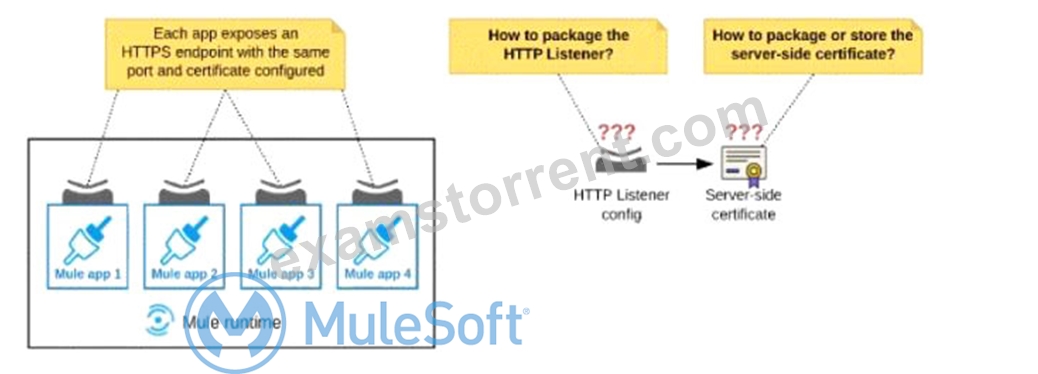
An organization deploys multiple Mule applications to the same customer -hosted Mule runtime. Many of these Mule applications must expose an HTTPS endpoint on the same port using a server-side certificate that rotates often.
What is the most effective way to package the HTTP Listener and package or store the server-side certificate when deploying these Mule applications, so the disruption caused by certificate rotation is minimized?
- A. Package an HTTPS Listener configuration In all Mule APPLICATIONS that need to expose an HTTPS endpoint Package the server-side certificate in a NEW Mule DOMAIN project
- B. Package the HTTPS Listener configuration in a Mule DOMAIN project, referencing it from all Mule applications that need to expose an HTTPS endpoint Store the server-side certificate in a shared filesystem location in the Mule runtime's classpath, OUTSIDE the Mule DOMAIN or any Mule APPLICATION
- C. Package the HTTPS Listener configuration in a MuleDOMAIN project, referencing It from all Mule applications that need to expose an HTTPS endpoint Package the server-side certificatein the SAME Mule DOMAIN projectGo to Set
- D. Package the HTTPS Listener configuration in a Mule DOMAIN project, referencing it from all Mule applications that need to expose an HTTPS endpoint Package the server-side certificate in ALL Mule APPLICATIONS that need to expose an HTTPS endpoint
Answer: B
NEW QUESTION 26
What is true about the network connections when a Mule application uses a JMS connector to interact with a JMS provider (message broker)?
- A. The AMQP protocol can be used by the JMS connectorto portably establish connections to various types of JMS providers
- B. The JMS connector supports both sending and receiving of JMS messages over the protocol determined by the JMS provider
- C. To complete sending a JMS message, the JMS connector must establish a network connection with the JMS message recipient
- D. To receive messages into the Mule application, the JMS provider initiates a network connection to the JMS connector and pushes messages along this connection
Answer: B
NEW QUESTION 27
49 of A popular retailer is designing a public API for its numerous business partners. Each business partner will invoke the API at the URL 58. https://api.acme.com/partnefs/vl. The API implementation is estimated to require deployment to 5 CloudHub workers.
The retailer has obtained a public X.509 certificate for the name apl.acme.com, signed by a reputable CA, to be used as the server certificate.
Where and how should the X.509 certificate and Mule applications be used to configure load balancing among the 5 CloudHub workers, and what DNS entries should be configured in order for the retailer to support its numerous business partners?
- A. Add the X.509 certificate to the Mule application's deployable archive, then configure a CloudHub Dedicated Load Balancer (DLB) for each of the Mule application's CloudHub workers Create a CNAME for api.acme.com pointing to the DLB's A record
- B. Add the X.509 certificate to a CloudHub Dedicated Load Balancer (DLB), not to the Mule application Create a CNAME for api.acme.com pointing to the DLB's A record
- C. Add the x.509 certificate to the Mule application's deployable archive, then configure the CloudHub Shared Load Balancer (SLB) for each of the Mule application's CloudHub workers Create a CNAME for api.acme.com pointing to the SLB's A record
- D. Add the X.509 certificate to the CloudHub Shared Load Balancer (SLB), not to the Mule application Create a CNAME for api.acme.com pointing to the SLB's A record
Answer: B
NEW QUESTION 28
What is required before an API implemented using the components of Anypoint Platform can be managed and governed (by applying API policies) on Anypoint Platform?
- A. The API must be published to Anypoint Exchange and a corresponding API instance ID must be obtained from API Manager to be used in the API implementation
- B. The API must be shared with the potential developers through an API portal so API consumers can interact with the API
- C. The API implementation source code must be committed to a source control management system (such as GitHub)
- D. A RAML definition of the API must be created in API designer so it can then be published to Anypoint Exchange
Answer: D
NEW QUESTION 29
Refer to the exhibit.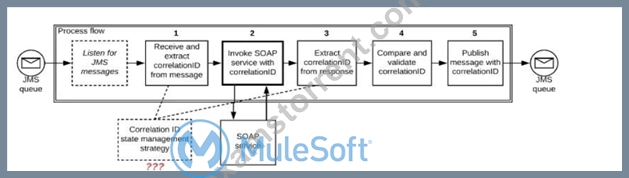
A Mule application isdeployed to a multi-node Mule runtime cluster. The Mule application uses the competing consumer pattern among its cluster replicas to receive JMS messages from a JMS queue. To process each received JMS message, the following steps are performed in a flow:
Step l: The JMS Correlation ID header is read from the received JMS message.
Step 2: The Mule application invokes an idempotent SOAP webservice over HTTPS, passing the JMS Correlation ID as one parameter in the SOAP request.
Step 3: The response fromthe SOAP webservice also returns the same JMS Correlation ID.
Step 4: The JMS Correlation ID received from the SOAP webservice is validated to be identical to the JMS Correlation ID received in Step 1.
Step 5: The Mule application creates aresponse JMS message, setting the JMS Correlation ID message header to the validated JMS Correlation ID and publishes that message to a response JMS queue.
Where should the Mule application store the JMS Correlation ID values received in Step 1 and Step 3so that the validation in Step 4 can be performed, while also making the overall Mule application highly available, fault-tolerant, performant, and maintainable?
- A. Both Correlation ID values should be stored in a persistent object store
- B. The Correlation ID value in Step 1 should be stored in a persistent object store The Correlation ID value in step 3 should be stored as a Mule event variable/attribute
- C. Both Correlation IDvalues should be stored as Mule event variable/attribute
- D. Both Correlation ID values should be stored In a non-persistent object store
Answer: C
NEW QUESTION 30
An organization's security policies mandate complete control of the login credentials used to log in to Anypoint Platform. What feature of Anypoint Platform should be used to meet this requirement?
- A. Enterprise Security Module
- B. Federated Identity Management
- C. Client ID Secret
- D. Federated Client Management
Answer: B
NEW QUESTION 31
A Mule application is being designed To receive nightly a CSV file containing millions of records from an external vendor over SFTP, The records from the file need to be validated, transformed. And then written to a database. Records can be inserted into the database in any order.
In this use case, what combination of Mule components provides the most effective and performant way to write these records to the database?
- A. Use a DataWeave map operation and an Async scope to insert records one by one into the database.
- B. Use a Scatter-Gather to bulk insert records into the database
- C. Use a Parallel for Each scope to Insert records one by one into the database
- D. Use a Batch job scope to bulk insert records into the database.
Answer: D
NEW QUESTION 32
Refer to the exhibit.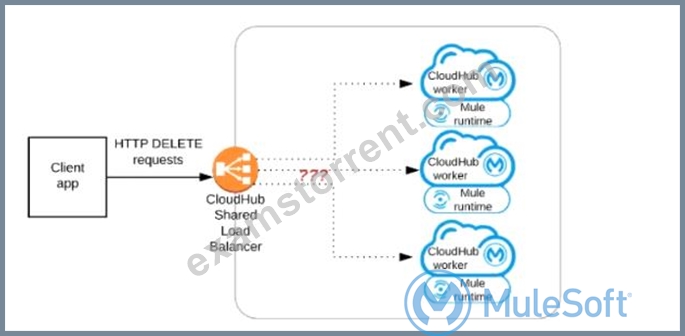
A Mule application has an HTTP Listener that accepts HTTP DELETE requests. This Mule application Is deployed to three CloudHub workers under the control of the CloudHub Shared Load Balancer.
A web client makes a sequence of requests to the Mule application's public URL.
How is this sequence of web client requests distributed among the HTTP Listeners running in the three CloudHub workers?
- A. Each request is routed (scattered) to ALL three CloudHub workers at the same time
- B. Each request Is routed to ONE ARBiTRARY CloudHub worker out of ALL three CloudHub workers
- C. Each request is routed to the PRIMARY CloudHub worker in the PRIMARY Availability Zone (AZ)
- D. Each request is routed to ONE ARBiTRARY CloudHub worker in the PRIMARY Availability Zone (AZ)
Answer: B
NEW QUESTION 33
Refer to the exhibit.
A Mule application is being designed to be deployed to several CIoudHub workers. The Mule application's integration logic is to replicate changed Accounts from Satesforce to a backend system every 5 minutes.
A watermark will be used to only retrieve those Satesforce Accounts that have been modified since the last time the integration logic ran.
What is the most appropriate way to implement persistence for the watermark in order to support the required data replication integration logic?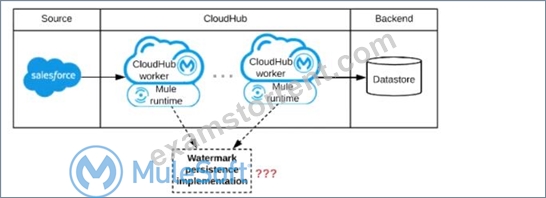
- A. Persistent VM Queue
- B. Persistent Anypoint MQ Queue
- C. Persistent Object Store
- D. Persistent Cache Scope
Answer: C
NEW QUESTION 34
When using Anypoint Platform across various lines of business with their own Anypoint Platform business groups, what configuration of Anypoint Platform is always performed at the organization level as opposed to at the business group level?
- A. Environment setup
- B. Role and permission setup
- C. Dedicated Load Balancer setup
- D. Identity management setup
Answer: D
NEW QUESTION 35
An organization has decided on a cloudhub migration strategy that aims to minimize the organizations own IT resources. Currently, the organizational has all of its Mule applications running on its own premises and uses an premises load balancer that exposes all APIs under the base URL https://api.acme.com As part of the migration strategy, the organization plans to migrate all of its Mule applications and load balancer to cloudhub What is the most straight-forward and cost effective approach to the Mule applications deployment and load balancing that preserves the public URLs?
- A. For each migrated Mule application, deploy an API proxy Mule application to Cloudhub with all applications under the control of a dedicated load balancer(CLB) Update the CNAME record for api.acme.com in the organization DNS server pointing to the A record of a cloudhub dedicated load balancer(DLB) Apply mapping rules in the DLB to map each API proxy application to its corresponding Mule applications
- B. Deploy the Mule applications to Cloudhub
Update the CNAME record for api.acme.com in the organization DNS server pointing to the A record of the cloudhub shared load balancer(SLB) Apply mapping rules in the SLB to map URLs to their corresponding Mule applications. - C. Deploy the Mule applications to Cloudhub
Create CNAME record for api.acme.com in the Cloudhub Shared load balancer (SLB) pointing to the A record of the on-premise load balancer Apply mapping rules in the SLB to map URLs to their corresponding Mule applications - D. Deploy the Mule applications to Cloudhub
Update the CNAME record for an api.acme.com in the organizations DNS server pointing to the A record of a cloudhub dedicated load balancer(DLB) Apply mapping rules in the DLB to map URLs to their corresponding Mule applications
Answer: D
Explanation:
https://help.mulesoft.com/s/feed/0D52T000055pzgsSAA.
NEW QUESTION 36
Refer to the exhibit.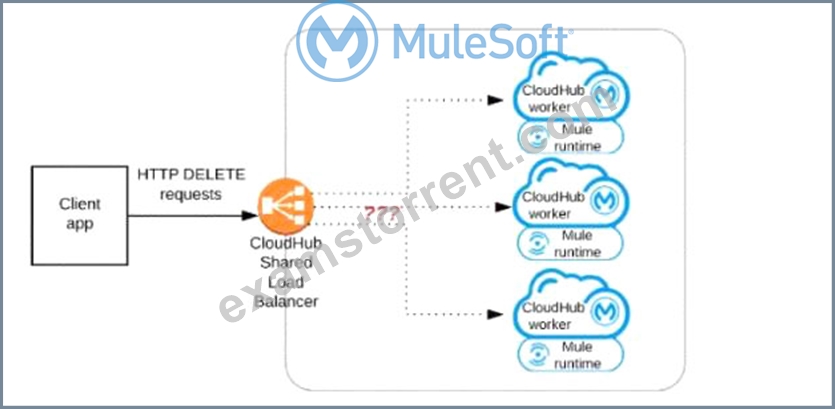
A Mule application has an HTTP Listener that accepts HTTP DELETE requests. This Mule application Is deployed to three CloudHub workers under the control of the CloudHub Shared Load Balancer.
A web client makes a sequence of requests to the Mule application's public URL.
How is this sequence of web client requests distributed among the HTTP Listeners running in the three CloudHub workers?
- A. Each request is routed (scattered) to ALL three CloudHub workers at the same time
- B. Each request Is routed to ONE ARBiTRARY CloudHub worker out of ALL three CloudHub workers
- C. Each request is routed to the PRIMARY CloudHub worker in the PRIMARY Availability Zone (AZ)
- D. Each request is routed to ONE ARBiTRARYCloudHub worker in the PRIMARY Availability Zone (AZ)
Answer: B
NEW QUESTION 37
What Anypoint Connectors support transactions?
- A. Database, JMS, VM
- B. Database, VM, File
- C. Database, 3MS, HTTP
- D. Database, JMS, VM, SFTP
Answer: A
NEW QUESTION 38
A mule application is being designed to perform product orchestration. The Mule application needs to join together the responses from an inventory API and a Product Sales History API with the least latency.
To minimize the overall latency. What is the most idiomatic (used for its intended purpose) design to call each API request in the Mule application?
- A. Call each API request in a separate route of a Parallel For Each scope
- B. Call each API request in a separate route of a Scatter-Gather
- C. Call each API request in a separate Async scope
- D. Call each API request in a separate lookup call from Dataweave reduce operator
Answer: B
NEW QUESTION 39
Refer to the exhibit. A Mule 4 application has a parent flow that breaks up a JSON array payload into 200 separate items, then sends each item one at a time inside an Async scope to a VM queue.
A second flow to process orders has a VM Listener on the same VM queue. The rest of this flow processes each received item by writing the item to a database.
This Mule application is deployed to four CloudHub workers with persistent queues enabled.
What message processing guarantees are provided by the VM queue and the CloudHub workers, and how are VM messages routed among the CloudHub workers for each invocation of the parent flow under normal operating conditions where all the CloudHub workers remain online?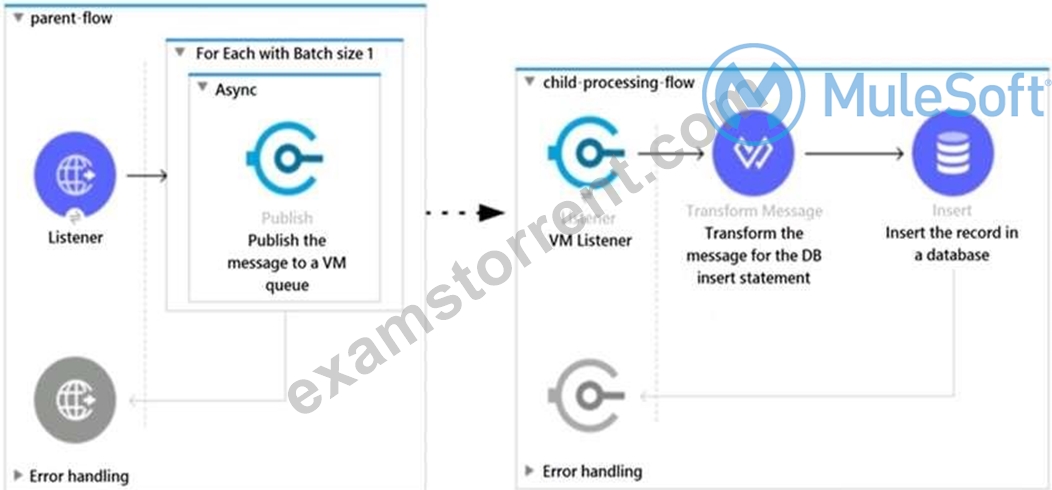
- A. EACH item VM message is processed AT LEAST ONCE by ONE ARBITRARY CloudHub worker Each of the four CloudHub workers can be expected to process some item VM messages
- B. EACH item VM message is processed AT MOST ONCE by ONE CloudHub worker, with workers chosen in a deterministic round-robin fashion Each of the four CloudHub workers can be expected to process 1/4 of the item VM messages (about 50 items)
- C. ALL item VM messages are processed AT LEAST ONCE by the SAME CloudHub worker where the parent flow was invoked This one CloudHub worker processes ALL 200 item VM messages
- D. ALL item VM messages are processed AT MOST ONCE by ONE ARBITRARY CloudHub worker This one CloudHub worker processes ALL 200 item VM messages
Answer: C
NEW QUESTION 40
......
ExamsTorrent MCIA-Level-1 Exam Practice Test Questions : https://www.examstorrent.com/MCIA-Level-1-exam-dumps-torrent.html