


NSE6_FSW-7.2 Dumps are Available for Instant Access [2025]
Practice with these NSE6_FSW-7.2 dumps Certification Sample Questions
Fortinet NSE6_FSW-7.2, also known as Fortinet NSE 6 - FortiSwitch 7.2 Certification Exam, is a certification program designed for network professionals who want to validate their skills and knowledge in configuring, managing, and troubleshooting FortiSwitch products. Fortinet NSE 6 - FortiSwitch 7.2 certification program is essential for individuals who want to specialize in Fortinet's network security solutions and advance their careers in the field of cybersecurity.
The NSE6_FSW-7.2 exam is designed for network administrators, engineers, and architects who work with FortiSwitch solutions on a daily basis. Fortinet NSE 6 - FortiSwitch 7.2 certification exam provides a way for professionals to validate their knowledge and skills, demonstrate their expertise to employers, and enhance their career prospects. NSE6_FSW-7.2 exam is available globally, and you can take it at a Pearson VUE testing center or online through the Pearson VUE OnVUE platform.
NEW QUESTION # 14
Which statement about the IGMP snooping querier when enabled on a VLAN is true?
- A. All other indirectly connected switches will be unable to get IGMP multicast traffic.
- B. IGMP reports on the VLAN are forwarded to all switch ports.
- C. The setting can only be enabled using the FortiSwitch CLI.
- D. Active multicast receiver entries are aging on each IGMP query sent on the VLAN
Answer: A
NEW QUESTION # 15
Refer to the exhibit.
Which two statements best describe what is displayed in the FortiLink debug output shown in the exhibit? (Choose two.)
- A. FortiSwitch is discovered and authorized by FortiGate.
- B. FortiSwitch is ready to push its new hostname to FortiGate.
- C. FortiSwitch is sending FortiLink heartbeats to FortiGate.
- D. FortiSwitch is in a waiting state to join the stack group on FortiGate.
Answer: A,C
NEW QUESTION # 16
Which two statements about 802.1X authentication on FortiSwitch ports are true? (Choose two.)
- A. A local user database must be used to authenticate devices using the 802.1X authentica-tion protocol.
- B. All hosts behind an authenticated port are allowed access after a successful authentica-tion.
- C. All devices connecting to FortiSwitch must support 802.1X authentication.
- D. A security policy is used to apply 802.1 authentication on a port.
Answer: B,D
NEW QUESTION # 17
In which two ways can you assign a FortiSwitch port to a VDOM using multi-tenancy setup? (Choose two.)
- A. Assign a port to a VDOM directly on the managed FortiSwitch.
- B. Create a virtual port pool on the FortiGate CLI.
- C. Switch the FortiLink interface to the target VDOM.
- D. Remove the managed FortiSwitch and allocate ports directly on FortiSwitch.
Answer: A,B
NEW QUESTION # 18
Which is a requirement to enable SNMP v2c on a managed FortiSwitch?
- A. Specify an SNMP host to send traps to.
- B. Enable an SNMP v3 to handle traps messages with SNMP hosts.
- C. Create an SNMP user to use for authentication and encryption.
- D. Configure SNMP agent and communities.
Answer: D
Explanation:
To enable SNMP v2c on a managed FortiSwitch, the essential requirement involves configuring the SNMP agent and community strings:
Configure SNMP Agent and Communities (D):
SNMP Agent: Activating the SNMP agent on FortiSwitch allows it to respond to SNMP requests.
Community Strings: SNMP v2c uses community strings for authentication. These strings function as passwords to grant read-only or read-write access to the SNMP data.
Understanding Other Options:
Create an SNMP user (A) is necessary for SNMP v3, not v2c, as it involves user-based authentication and encryption.
Specify an SNMP host (B) is typically a part of SNMP configuration but not a requirement just to enable SNMP.
Enable SNMP v3 (C) is not related to enabling SNMP v2c.
Reference:
For detailed instructions on configuring SNMP on FortiSwitch, you can refer to the SNMP configuration section in the FortiSwitch administration guide available on: Fortinet Product Documentation
NEW QUESTION # 19
Exhibit.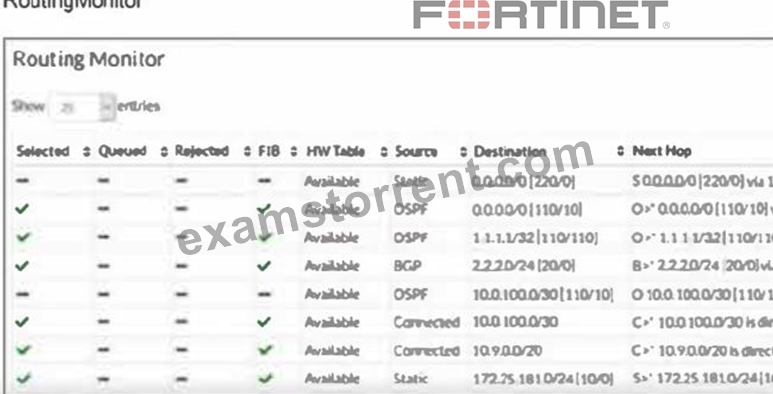
Two routes are not installed in the forwarding information base (FIB) as shown in the exnibit. Which two statements about these two route entries are true? (Choose two.)
- A. These two routes will become primary, if the best routes are removed.
- B. These two routes are available in the hardware routing table.
- C. These two routes have a higher administrative distance value available to the destination networks.
- D. These two routes will be used as load-balancing routes.
Answer: A,C
Explanation:
From the exhibit and the details given about the routes not installed in the FIB:
These two routes have a higher administrative distance value available to the destination networks (Option A): Administrative distance is a measure used by routers to select the best path when there are two or more different routes to the same destination from two different routing protocols. A higher administrative distance means that the route is considered less trustworthy, thus not selected for the FIB unless the more preferred routes fail.
These two routes will become primary, if the best routes are removed (Option B): In routing, if the currently installed routes (which are considered the best due to reasons like lower administrative distance) are removed or become unavailable, the next best routes based on administrative distance will be used. This behavior ensures redundancy and maintains network connectivity in diverse scenarios.
Reference:
This approach is aligned with standard routing protocol behavior as documented in networking protocols and Fortinet's routing mechanisms which prioritize routes based on administrative distance and other metrics to maintain efficient and reliable network routing.
NEW QUESTION # 20
Refer to the diagnostic output: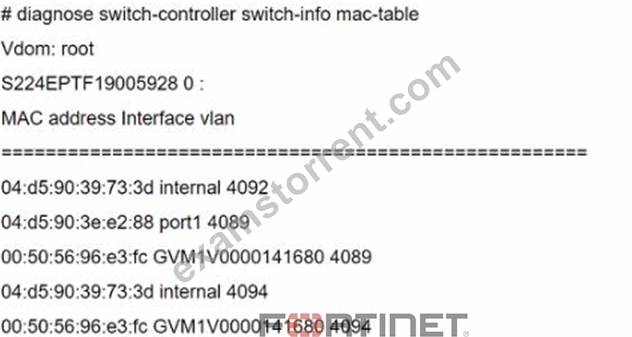
Two entries in the exhibit show that the same MAC address has been used in two different VLANs. Which MAC address is shown in the above output?
- A. It is a MAC address of FortiGate in HA configuration.
- B. It is a MAC address of a switch that accepts multiple VLANs.
- C. It is a MAC address of an upstream FortiSwitch.
- D. It is a MAC address of FortiLink interface on FortiGate.
Answer: B
Explanation:
The MAC address "00:50:56:96:e3:fc" appearing in two different VLANs (4089 and 4094) in the diagnostic output indicates it is a MAC address associated with a device that supports traffic from multiple VLANs. Such a behavior is typical of network infrastructure devices like switches or routers, which are configured to allow traffic from various VLANs to pass through a single physical or logical interface. This is essential in network designs that utilize VLANs to segregate network traffic for different departments or use cases while using the same physical infrastructure.
Reference:
For more detailed information on MAC table diagnostics and VLAN configurations in FortiGate devices, refer to the official Fortinet documentation: Fortinet Product Documentation.
NEW QUESTION # 21
Which two statements about the FortiLink authorization process are true? (Choose two.)
- A. A FortiLink frame is sent by FortiGate to FortiSwitch to complete the authorization.
- B. FortiLink authorization sets the FortiSwitch management mode to FortiLink.
- C. FortiSwitch requires a reboot to complete the authorization process.
- D. The administrator must manually pre-authorize FortiGate on FortiSwitch by adding the FortiGate serial number.
Answer: A,B
NEW QUESTION # 22
Which statement about the configuration of VLANs on a managed FortiSwitch port is true?
- A. Allowed VLANS expand the collision domain to the port.
- B. Untagged VLANs must be part of the allowed VLANs: ingress and egress.
- C. The native VLAN is implicitly part of the allowed VLAN on the port.
- D. FortiSwitch VLAN interfaces are created only when FortiSwitch is managed by Forti-Gate.
Answer: C
NEW QUESTION # 23
FortiGate is unable to establish a tunnel with the FortiSwitch device it is supposed to manage Based on the debug output shown in the exhibit, what is the reason for the failure?
- A. FortiSwitch has disabled FortiLink and is only managed as a standalone.
- B. DTLS client hello had the incorrect pre-shared key.
- C. The CAPWAP tunnel failed to come up due to a mismatch in time.
- D. The handshake process timed out before FortiSwitch responded.
Answer: C
NEW QUESTION # 24
Which two rules used by MSTP are similar to rules used by other STP methods? (Choose two.)
- A. MSTP uses port role election, similar to rapid STP on the instances.
- B. MSTP uses root bridge selection, similar to rapid STP
- C. MSTP uses alternate path and primary path, similar to regular STP.
- D. MSTP uses timers for transitioning the ports, similar to regular STP.
Answer: B,C
NEW QUESTION # 25
What can an administrator do to maintain a FortiGate-compatible FortiSwitch configuration when changing the management mode from standalone to FortiLinK?
- A. FortiGate automatically saves the existing FortiSwitch configuration during the FortiLink management process.
- B. Use a migration tool based on Python script to convert the configuration.
- C. Register FortiSwitch to FortiSwitch Cloud to save a copy before managing with FortiGate.
- D. Enable the FortiLink setting on FortiSwitch before the authorization process.
Answer: A
Explanation:
When transitioning the management of a FortiSwitch from standalone mode to being managed by FortiGate via FortiLink, it is critical to ensure that the existing configurations are preserved. The best practice involves:
FortiGate's Role in Configuration Preservation:
FortiGate has the capability to automatically preserve the existing configuration of a FortiSwitch when it is integrated into the network via FortiLink. This feature helps ensure that the transition does not disrupt the network's operational settings.
Configuration Integration:
As FortiSwitch is integrated into FortiGate's management via FortiLink, FortiGate captures and integrates the existing switch configuration, enabling a seamless transition. This process involves FortiGate recognizing the FortiSwitch and its current setup, then incorporating these settings into the centralized management interface without the need for manual reconfiguration or the use of additional tools.
Reference:
For further details on managing FortiSwitch with FortiGate and the capabilities of FortiLink, consult the FortiSwitch and FortiGate integration guide available on: Fortinet Product Documentation
NEW QUESTION # 26
What can an administrator do to maintain a FortiGate-compatible FortiSwitch configuration when changing the management mode from standalone to FortiLinK?
- A. FortiGate automatically saves the existing FortiSwitch configuration during the FortiLink management process.
- B. Use a migration tool based on Python script to convert the configuration.
- C. Enable the FortiLink setting on FortiSwitch before the authorization process.
- D. Register FortiSwitch to FortiSwitch Cloud to save a copy before managing with FortiGate.
Answer: D
NEW QUESTION # 27
Which two statements about managing a FortiSwitch stack on FortiGate are true? (Choose two.)
- A. A FortiLink interface must be enabled on FortiGate.
- B. Only a hardware-based FortiGate can manage a FortiSwitch stack.
- C. The switch controller feature must be enabled on FortiGate.
- D. FortiSwitch must be operating in standalone mode before authorization.
Answer: A,C
NEW QUESTION # 28
Exhibit.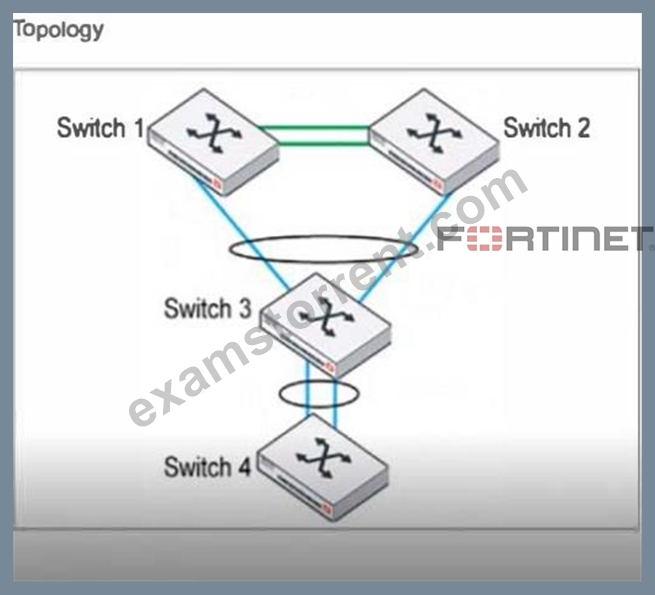
LAG and MCLAG are used to increase the available network bandwidth and enable redundancy. How does spanning tree protocol see MCLAG and LAG if they are configured based on the physi-cal view shown in the exhibit? (Choose two)
- A. Switch 3 and switch 4 are seen as one MCLAG switch client
- B. Switch 3 and Switch 4 uplinks are treated as single interfaces.
- C. Switch 1. Switch 2, and Switch 3 are seen as one MCLAG peer group
- D. Switch 1 and Switch 2 both seen as one single switch.
Answer: A,D
NEW QUESTION # 29
Which two statements about the FortiLink authorization process are true? (Choose two.)
- A. A FortiLink frame is sent by FortiGate to FortiSwitch to complete the authorization.
- B. FortiLink authorization sets the FortiSwitch management mode to FortiLink.
- C. FortiSwitch requires a reboot to complete the authorization process.
- D. The administrator must manually pre-authorize FortiGate on FortiSwitch by adding the FortiGate serial number.
Answer: A,B
Explanation:
The FortiLink authorization process is an integral part of setting up FortiSwitch to be managed by FortiGate. The correct statements regarding the FortiLink authorization process are:
C . A FortiLink frame is sent by FortiGate to FortiSwitch to complete the authorization. This is a part of the FortiLink protocol, where FortiGate communicates with the connected FortiSwitch to establish management and control. This frame initiates the configuration and management process, allowing FortiGate to effectively control the switch.
D . FortiLink authorization sets the FortiSwitch management mode to FortiLink. Once authorized, the management mode of FortiSwitch is set to FortiLink, indicating that it is being managed via a FortiLink connection from a FortiGate appliance. This changes the operational mode of the switch to be under the control of the FortiGate for centralized management and policy application.
Reference:
Further details on the FortiLink setup and authorization process can be accessed through the FortiGate configuration guides available on the Fortinet Documentation site.
NEW QUESTION # 30
Refer to the exhibit.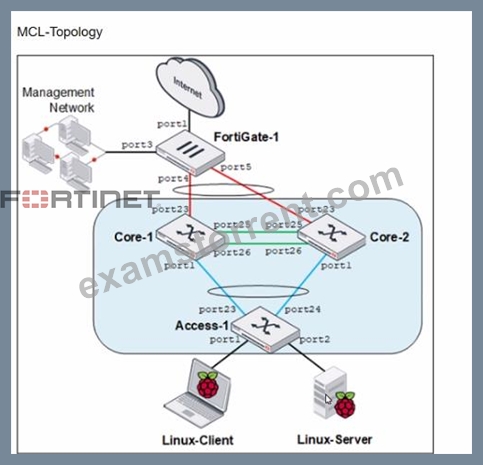
Core-1 and Access-1 are managed and authorized by FortiGate-1. which uses port4 as the FortiLink interface. After FortiGate authorizes and manages Core-2. Port1 status becomes STP discarding.
Why is port1 in the discarding state?
- A. Core-2 has the lowest bridge priority.
- B. port1 on Core-2 is discarding only management traffic.
- C. Core-1 and Core-2 do not have MCLAG configuration.
- D. Access-1 is the root bridge and can only have one root port.
Answer: C
Explanation:
The STP (Spanning Tree Protocol) discarding state on port1 of Core-2, after Core-1 and Access-1 are managed and authorized by FortiGate-1, is likely due to the lack of an MCLAG (Multi-Chassis Link Aggregation Group) configuration between Core-1 and Core-2. In typical network configurations involving STP and MCLAG, the absence of MCLAG can lead to STP blocking one of the redundant paths to prevent loops, which is a critical function of STP. Port1 on Core-2 being in a discarding state suggests that it has been identified as providing a redundant path that could potentially create a network loop, hence STP has placed this port in a blocking (discarding) state to maintain a loop-free topology.
Reference:
For a deeper understanding of STP operations and MCLAG configurations in FortiGate managed environments, consult the Fortinet knowledge base: Fortinet Knowledge Base.
NEW QUESTION # 31
Which is a requirement to enable SNMP v2c on a managed FortiSwitch?
- A. Specify an SNMP host to send traps to.
- B. Enable an SNMP v3 to handle traps messages with SNMP hosts.
- C. Create an SNMP user to use for authentication and encryption.
- D. Configure SNMP agent and communities.
Answer: D
NEW QUESTION # 32
Which statement about the IGMP snooping querier when enabled on a VLAN is true?
- A. IGMP reports on the VLAN are forwarded to all switch ports.
- B. Active multicast receiver entries are aging on each IGMP query sent on the VLAN
- C. The setting can only be enabled using the FortiSwitch CLI.
- D. All other indirectly connected switches will be unable to get IGMP multicast traffic.
Answer: B
Explanation:
Active multicast receiver entries are aging on each IGMP query sent on the VLAN (A): When IGMP snooping querier is enabled on a VLAN, it functions to manage multicast traffic within the VLAN by keeping track of multicast group memberships. The IGMP querier sends queries to determine which ports require the multicast traffic. The multicast receiver entries, which are entries that indicate which devices have requested the multicast data, age or time out based on these IGMP queries. Each query refreshes active connections but ages out entries that no longer respond, helping to ensure that multicast traffic is only sent to ports with active receivers.
NEW QUESTION # 33
Exhibit.
LAG and MCLAG are used to increase the available network bandwidth and enable redundancy. How does spanning tree protocol see MCLAG and LAG if they are configured based on the physi-cal view shown in the exhibit? (Choose two)
- A. Switch 3 and Switch 4 uplinks are treated as single interfaces.
- B. Switch 1 and Switch 2 both seen as one single switch.
- C. Switch 3 and switch 4 are seen as one MCLAG switch client
- D. Switch 1. Switch 2, and Switch 3 are seen as one MCLAG peer group
Answer: A,D
Explanation:
In the context of the topology provided and the concepts of LAG (Link Aggregation Group) and MCLAG (Multi-Chassis Link Aggregation), the spanning tree protocol's perspective can be summarized as follows:
Switch 1, Switch 2, and Switch 3 are seen as one MCLAG peer group (Option A): In this configuration, Switches 1 and 2 form a Multi-Chassis Link Aggregation Group (MCLAG) which effectively allows them to act as a single logical entity from the perspective of downstream switches (in this case, Switch 3). This grouping enhances fault tolerance and bandwidth by pooling the link resources of the two switches.
Switch 3 and Switch 4 uplinks are treated as single interfaces (Option B): This option suggests that the connections between Switch 3 and Switch 4 (presumably using LAG) are perceived by the spanning tree protocol as a single logical connection. This perception is due to the LAG configuration, which combines multiple network cables/ports into a single logical link to provide redundancy and increase bandwidth.
Reference:
The use of LAG and MCLAG is well-documented in networking literature and Fortinet's own documentation, as these technologies are commonly employed to enhance redundancy and bandwidth. Fortinet's implementation of these protocols is designed to maintain compatibility with standard networking protocols, including Spanning Tree Protocol (STP).
NEW QUESTION # 34
Exhibit.
port24 is the only uplink port connected to the network where access to FortiSwitch management services is possible. However, FortiSwitch is still not accessible on the management interface. Which two actions should you take to fix the issue and access FortiSwitch? (Choose two.)
- A. You must add port24 native VLAN as an allowed VLAN on internal.
- B. You must allow VLAN ID 4094 on port24, if management traffic is tagged.
- C. You must add VLAN ID 200 to the allowed VLANS on internal.
- D. You should use VLAN ID 4094 as the native VLAN on port24.
Answer: A,B
Explanation:
To enable access to the FortiSwitch management interface from the network, certain configuration adjustments need to be made, particularly considering the VLAN settings displayed in the exhibit:
Adding port24 native VLAN to the allowed VLANs on internal (Option A): The management VLAN (VLAN 4094 in this case, as it is set as the native VLAN on the 'internal' interface of the FortiSwitch) must be included in the allowed VLANs on the interface that provides management connectivity. Since port24 is set with a different native VLAN (VLAN 100), VLAN 4094 (the management VLAN) should be allowed through to ensure connectivity.
Allow VLAN ID 4094 on port24 if management traffic is tagged (Option C): Management traffic is tagged on VLAN 4094. Since port24 is connected to the network and serves as an uplink, allowing VLAN 4094 ensures that management traffic can reach the management interface of the FortiSwitch through this port.
The changes align with Fortinet's best practices for setting up management VLANs and ensuring they are permitted on the relevant switch ports for proper management traffic flow.
Reference:
FortiGate Infrastructure and Security 7.2 Study Guides
Best practices for VLAN configurations in Fortinet's technical documentation
NEW QUESTION # 35
How does FortiGate handle configuration of flow tracking sampling if you export the settings to a managed FortiSwitch stack with sampling mode set to perimeter is true?
- A. FortiGate configures FortiSwitch to perform ingress sampling on all switch interfaces.
- B. FortiGate configures FortiSwitch to perform ingress sampling on all switch interfaces, except ICL and ISL interfaces.
- C. FortiGate configures and enables egress sampling on all management interfaces.
- D. FortiGate configures and enables flow sampling on FortiSwitch but does not change existing sampling settings of interfaces.
Answer: B
Explanation:
When FortiGate exports configuration settings to a managed FortiSwitch stack with sampling mode set to "perimeter is true," the behavior is:
B . FortiGate configures FortiSwitch to perform ingress sampling on all switch interfaces, except ICL and ISL interfaces. This setting ensures that all incoming traffic on normal operational ports is sampled for monitoring and analysis purposes, but it excludes the inter-chassis link (ICL) and inter-switch link (ISL) interfaces from sampling. These exclusions are typically made to prevent the duplication of sampled data and to reduce unnecessary load on the monitoring system, as these links often carry traffic already monitored at other points.
Options A and D are incorrect because they either generalize the sampling across all interfaces without exceptions or incorrectly specify egress sampling on management interfaces. Option C is also incorrect as FortiGate can modify existing sampling settings to fit the perimeter-based configuration requirement.
NEW QUESTION # 36
Which statement about the use of the switch port analyzer (SPAN) packet capture method is true?
- A. The monitoring device must be connected to the same switch where the traffic is being mirrored
- B. Traffic on the management interface can be mirrored and captured by the monitoring device.
- C. SPAN can be configured only on a standalone FortiSwitch.
- D. Mirrored traffic can be sent across multiple switches.
Answer: B
NEW QUESTION # 37
Which LLDP-MED Type-Length-Values does FortiSwitch collect from endpoints to track network devices and determine their characteristics?
- A. Location
- B. Network policy
- C. Inventory management
- D. Power management
Answer: C
NEW QUESTION # 38
Refer to the exhibits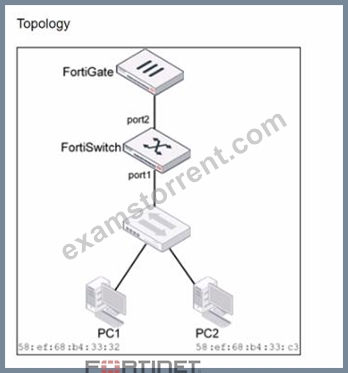
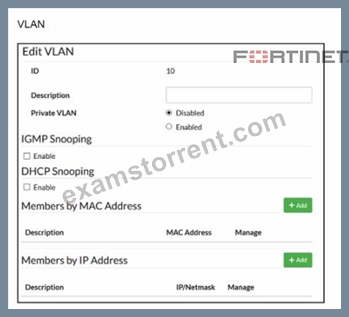
Traffic arriving on port2 on FortiSwitch is tagged with VLAN ID 10 and destined for PC1 connected on port1. PC1 expects to receive traffic untagged from port1 on FortiSwitch.
Which two configurations can you perform on FortiSwitch to ensure PC1 receives untagged traffic on port1? (Choose two.)
- A. Add the MAC address of PCI as a member of VLAN 10.
- B. Enable Private VLAN on VLAN 10 and add VLAN 20 as an isolated VLAN.
- C. Remove VLAN 10 from the allowed VLANs and add it to untagged VLANs on port1.
- D. Add VLAN ID 10 as a member of the untagged VLANs on port1.
Answer: A,D
Explanation:
The two reasons why port1 can be shut down are loop guard protection and Spanning Tree Protocol (STP).
Loop guard protection: This is a feature that helps to prevent switching loops in a network.expand_more A loop guard can be configured on a port to monitor for specific traffic patterns that indicate a loop. If loop guard protection detects a loop, it will shut down the port to prevent the loop from causing problems.
STP: STP is a protocol that helps to prevent switching loops.expand_more When multiple paths exist between two network devices, STP will block all but one of the paths, creating a loop-free topology.expand_more If STP detects a loop, it will shut down the ports that are involved in the loop.
In the exhibit, both ports 1 and 2 are configured with the same native VLAN 10. This configuration could create a switching loop if both ports are connected to devices on the same network segment. If a loop occurs, loop guard protection or STP could shut down port1 to prevent the loop from causing problems.
Reference:
Fortinet FortiSwitch 7.2 Administration Guide https://docs.fortinet.com/document/fortigate/7.4.3/administration-guide/954635/getting-started
NEW QUESTION # 39
......
Get Instant Access REAL NSE6_FSW-7.2 DUMP Pass Your Exam Easily: https://www.examstorrent.com/NSE6_FSW-7.2-exam-dumps-torrent.html
NSE6_FSW-7.2 Free Exam Questions with Quality Guaranteed: https://drive.google.com/open?id=1jaRqHH9iGAG6709swBASFPkwjlYYH281