


Instant Download UiPath-TAEPv1 Dumps Q&As Provide PDF&Test Engine
Fast Exam Updates UiPath-TAEPv1 dumps with PDF Test Engine Practice
UiPath UiPath-TAEPv1 Exam Syllabus Topics:
| Topic | Details |
|---|---|
| Topic 1 |
|
| Topic 2 |
|
| Topic 3 |
|
| Topic 4 |
|
| Topic 5 |
|
NEW QUESTION # 38
Considering the provided configuration for Workflow Analyzer Settings, how many testing rules applied will be classified as an "Error"?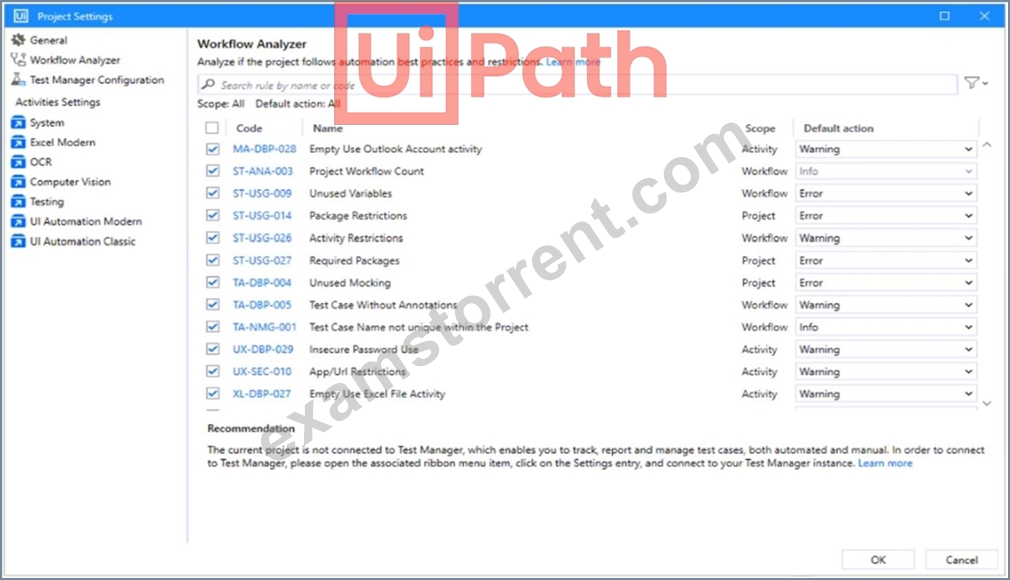
- A. 0
- B. 1
- C. 2
- D. 3
Answer: C
Explanation:
Based on the image, there are 4 Workflow Analyzer rules with the "Error" default action set:
ST-USG-009 - Unused Variables
ST-USG-014 - Package Restrictions
ST-USG-027 - Required Packages
TA-DBP-004 - Unused Mocking
These are all marked with "Error" in the Default action column.
NEW QUESTION # 39
What is a limitation when re-executing test case executions for data-driven test cases?
- A. Multiple data-driven test case executions can be re-executed at once.
- B. There is no limitation when re-executing data-driven test case executions.
- C. Only one test case execution can be re-executed at a time.
- D. Data-driven test case executions cannot be re-executed.
Answer: C
Explanation:
A limitation when re-executing data-driven test case executions is that only one test case execution can be re-executed at a time. This is due to the unique data sets tied to each execution, which require individual handling.
NEW QUESTION # 40
What programming language can be used in Coded Workflows?
- A. VB.Net
- B. C#
- C. VBScript
- D. C# and VB.Net
Answer: D
Explanation:
In Coded Workflows within UiPath, both C# and VB.Net can be used as programming languages. These languages provide flexibility for developers to write complex logic that cannot be achieved with the standard UiPath activities.
NEW QUESTION # 41
Which of the following descriptions matches the concept of Integration Testing?
- A. Evaluate the system's compliance with the business requirements and assess whether it is acceptable for delivery.
- B. Individual units are combined and tested as a group. The purpose of this level of testing is to expose faults in the interaction between integrated units.
- C. Validates the complete and fully integrated system. The purpose of a system test is to evaluate the end-to-end system specifications.
- D. Individual units of a system are tested. The purpose is to validate that each unit of the system code performs as expected.
Answer: B
Explanation:
Integration Testing focuses on testing combined units of a system to ensure they work together correctly. The goal is to detect issues in the interaction between modules or components after they are integrated.
NEW QUESTION # 42
What type of license is used for an Unattended Robot in development and testing mode, enabling it to execute both test cases and RPA processes?
- A. Testing
- B. NonProduction
- C. Citizen Developer
- D. RPA Developer
Answer: B
Explanation:
A NonProduction license is used for an Unattended Robot in development and testing mode, allowing it to execute both test cases and RPA processes. It is ideal for scenarios that simulate production without affecting live environments.
NEW QUESTION # 43
What color code in the status tab represents a test without a definitive results or that have not been executed yet but is a part of a test set that is currently being executed?
- A. Green
- B. Black
- C. Red
- D. Grey
Answer: D
Explanation:
In UiPath Test Manager, the Grey color code in the status tab represents a test case that has not yet been executed or does not have a definitive result, but is part of a test set that is currently being executed.
NEW QUESTION # 44
Where are Postman collection endpoint activities found after being imported into a Studio library?
- A. In the Activities tab, under the Postman imported libraries list.
- B. In the Activities tab, under the namespace that you have set.
- C. In the Debug tab, within the testing activities pack.
- D. In the Projects tab, under the namespace of the imported Postman collection.
Answer: B
Explanation:
After importing a Postman collection into a Studio library, the endpoint activities appear in the Activities tab, under the namespace that you have set during the import process. This makes them reusable across workflows.
NEW QUESTION # 45
When should a Test Data File in data-driven testing be used?
- A. A Test Data File is used only when there is a need to perform runtime data fetching from the first entry in the entity in UiPath Data Service.
- B. A Test Data File is useful when application testing requires working with large data sets to verify workflow execution and cover edge cases.
- C. A Test Data File should only be used when there is a need to perform tests using multiple argument types for a decision tree.
- D. A Test Data File is only used when there is a need to execute test cases containing data variations from UiPath Data Service in Orchestrator.
Answer: B
Explanation:
A Test Data File is best used in data-driven testing when the test cases need to handle large data sets to validate workflow behavior under different conditions and cover edge cases. It allows structured input variation without relying on external sources.
NEW QUESTION # 46
What are the tasks that can be executed from the UiPath command-line interface (CLI) while creating a CI/CD pipeline?
- A. Run, Test, Deploy, Pack, Help, Version.
- B. Asset Job, Package, Test, Help, Version.
- C. Analyze, Delete, Deploy, Pack.
- D. Job, Run, Deploy, Delete, Analyze.
Answer: A
Explanation:
The UiPath CLI supports several tasks useful for building CI/CD pipelines, including:
These tasks help integrate UiPath automation into automated build and deployment workflows.
NEW QUESTION # 47
Which are the types of coded automations in UiPath?
- A. Coded workflows, Coded test cases, Code source files.
- B. Workflows, Test cases, Source files.
- C. Coded workflows, Coded test cases, Coded functions.
- D. Coded workflows, Coded databases, Code source files.
Answer: C
Explanation:
The types of coded automations in UiPath include Coded Workflows, Coded Test Cases, and Coded Functions. These enable developers to write automation logic using code (e.g., C#) within a UiPath project, enhancing flexibility and control beyond drag-and-drop activities.
NEW QUESTION # 48
What are the specific benefits of using coded automations in UiPath?
- A. Coded automations are primarily used to create structured code with no enhanced productivity, performance improvement, or increased readability.
- B. Coding can increase productivity, manage complex automation scenarios, work seamlessly with low-code automations, enhance performance, and improve code readability.
- C. Coded automations allow to work with low-code automations only, manage basic automation scenarios and developers find it challenging to maintain the code.
- D. Coded automations are used only in complex automation scenarios and they have no role in productivity, performance, hybrid automation or code readability.
Answer: B
Explanation:
Coded automations in UiPath bring several benefits, including increased productivity, the ability to manage complex automation scenarios, seamless integration with low-code automations, improved performance, and better code readability. This enables developers to write more efficient and maintainable code, especially in scenarios where complex logic or custom functions are required.
NEW QUESTION # 49
What is a primary distinction between manual and automated test execution in UiPath Test Manager?
- A. Manual executions are done for test sets created in UiPath Test Manager or linked from Orchestrator with manual steps, while automated executions are invoked through Orchestrator for test cases linked from Studio.
- B. Automated test executions can be performed only in UiPath Orchestrator, while manual executions can only be performed in UiPath Test Manager.
- C. Manual executions require user interaction for each test step, while automated executions are self-running without any manual intervention.
- D. Manual and automated test executions do not have specific distinctions and can be executed interchangeably.
Answer: C
Explanation:
The primary distinction is that manual executions require user interaction for each test step, making them suitable for scenarios like exploratory testing or steps requiring human validation. In contrast, automated executions are fully self-running, executed via Orchestrator without manual involvement.
NEW QUESTION # 50
What happens if a Test Execution is re-executed?
- A. A log with all the previous executions is kept.
- B. A log with only the previous execution is kept.
- C. The old execution results are deleted and replaced with the new results.
- D. New test execution results are generated, independent from the previous ones.
Answer: D
Explanation:
When a Test Execution is re-executed in UiPath, it generates new test execution results that are independent of previous ones. This allows for historical tracking and comparison between multiple runs.
NEW QUESTION # 51
What actions can be done for test cases that contain data variation?
- A. Create test data, Update test data, and Modify test data JSON file.
- B. Create test data, Remove test data, and Modify test data JSON file.
- C. Create test data, Update test data, and Remove test data.
- D. Update test data, Remove test data, and Modify test data JSON file.
Answer: C
Explanation:
For test cases that contain data variation, you can Create, Update, and Remove test data. These actions allow you to manage different input scenarios effectively for data-driven testing without needing to manually edit the JSON file.
NEW QUESTION # 52
How can the activities covered during a test case execution in UiPath Studio be checked?
- A. By opening the Descriptor Coverage panel and double-clicking the test case.
- B. By checking the Run tab under Robot Executor.
- C. By opening the Activity Coverage panel and double-clicking the test case.
- D. By checking the Output tab in UiPath Studio.
Answer: C
Explanation:
The Activity Coverage panel in UiPath Studio shows which activities were executed during a test case run. By double-clicking the test case in this panel, you can review coverage and identify untested or redundant activities.
NEW QUESTION # 53
What are the key features of UiPath Test Manager and its integration with ALM solutions, facilitated by UiPath Test Manager Connect?
- A. UiPath Test Manager excludes agile planning and requirement management, and the integration is facilitated by UiPath itself.
- B. UiPath Test Manager is only compatible with ALM solutions for defect management, and the integration is facilitated by an external provider.
- C. UiPath Test Manager is compatible with leading ALM solutions, and the UiPath Test Manager Connect, provided by Planview, ensures bidirectional synchronization for seamless data exchange.
- D. UiPath Test Manager Connect offers a one-way synchronization of objects and supports a limited number of ALM tools.
Answer: C
Explanation:
UiPath Test Manager integrates with leading ALM solutions, and the UiPath Test Manager Connect (provided by Planview) enables bidirectional synchronization for requirements, defects, test cases, and results-ensuring seamless and real-time data exchange between UiPath and ALM platforms.
NEW QUESTION # 54
Where can robot authentication settings be seen and configured?
- A. Tenant > Settings, on the Robot security tab.
- B. Tenant > Preferences, on the Robot security tab.
- C. Tenant > Preferences, on the Robot connection tab.
- D. Tenant > Settings, on the Robot connection tab.
Answer: A
Explanation:
Robot authentication settings can be seen and configured in UiPath Orchestrator by navigating to Tenant > Settings, under the Robot security tab. This is where you manage how robots authenticate with Orchestrator.
NEW QUESTION # 55
How does the licensing model work for Testing runtimes in UiPath?
- A. It works by allocating a fixed number of licenses per testing robot, regardless of the maximum number that can execute tests simultaneously.
- B. It counts the maximum number of Testing robots that are able to execute tests simultaneously, given by the total number of runtimes allocated to all the online machines.
- C. It counts the individual testing robots on a machine and assigns each of them an equal number of licenses.
- D. It counts the total number of licenses available and divides them amongst the Testing robots.
Answer: B
Explanation:
The licensing model for Testing runtimes in UiPath is based on the maximum number of Testing robots that can execute tests simultaneously, which is determined by the total number of runtimes allocated to all online machines. This ensures efficient utilization of available resources.
NEW QUESTION # 56
According to best practices, how should the renaming, moving, or deleting of test cases in the project be handled?
- A. The renaming, moving or deleting of test cases can be handled either inside or outside Studio, there is no preferred way.
- B. Do not rename move or delete the test cases outside of Studio.
- C. Test cases can be renamed, moved or deleted outside of Studio.
- D. Test cases should be renamed or moved outside of Studio and then re-imported.
Answer: B
Explanation:
According to best practices, test cases should not be renamed, moved, or deleted outside of UiPath Studio. Making such changes externally can lead to discrepancies in the project structure and potentially break links or references within the testing framework. Performing these actions within Studio ensures that all changes are properly tracked and synchronized across the test suite.
NEW QUESTION # 57
How to document a test case using Task Capture?
- A. 1. Open the project in Test Manager
2. Open the Test Requirement tab
3. Open the Manual Steps tab
4. Click Document with Task Capture
5. Stat capture the test steps based on the test case description - B. 1. Open the project in Test Manager
2. Open a test case in Test Manager that should be documented
3. Open the Manual Steps tab
4. Click Document with Task Capture
5. Stat capture the test steps based on the test case description - C. 1. Open the project in Test Manager
2. Open a test case in Test Manager that should be documented
3. Open the Test Requirement tab
4. Open the Manual Steps tab
5. Stat capture the test steps based on the test case description - D. 1. Open the project in Test Manager
2. Open the Test Requirement tab
3. Open a test case in Test Manager that should be documented
4. Click Document with Task Capture
5. Start capturing the test steps based on the test case description
Answer: B
Explanation:
To document a test case using Task Capture, you need to:
Open the project in Test Manager
Open the specific test case to be documented
Navigate to the Manual Steps tab
Click Document with Task Capture
Start capturing the test steps based on the test case description
This process ensures that manual test steps are accurately captured and linked to the test case for better traceability and clarity.
NEW QUESTION # 58
What factors influence the calculation of coverage in the Descriptor Coverage feature in UiPath?
- A. The total number of selectors available in the Object Repository.
- B. The total number of selectors in a test case execution.
- C. The number of times a selector has been successfully executed.
- D. The number of selectors that have been manually verified.
Answer: C
NEW QUESTION # 59
Which are the supported object types when creating a new custom field in UiPath Test Manager?
- A. Test set and defect
- B. Defect and requirement.
- C. Requirement and test set.
- D. Test case and test result.
Answer: C
Explanation:
In UiPath Test Manager, when creating a new custom field, the supported object types are Requirement and Test Set. This allows teams to define additional metadata specific to project needs for better organization and tracking.
NEW QUESTION # 60
Which are the sub-tasks available under test task in UiPath CLI?
- A. Convert: converts test results written in JSON or CSV to another format.
Run: tests a given package, or runs an existing Test Set on Orchestrator. - B. Convert: converts test results written in JSON to another format.
Test: tests a given package. - C. Convert: converts test results written as CSV to another format.
Run: tests a given package, or runs an existing Test Set on Orchestrator. - D. Convert: converts test results written in JSON to another format.
Run: tests a given package, or runs an existing Test Set on Orchestrator.
Answer: A
Explanation:
Run: runs an existing Test Set on Orchestrator.
Explanation:
In the UiPath CLI, the test task includes the following sub-tasks:
These enable integration of test execution and reporting into CI/CD pipelines.
NEW QUESTION # 61
......
Exam Valid Dumps with Instant Download Free Updates: https://www.examstorrent.com/UiPath-TAEPv1-exam-dumps-torrent.html
UiPath-TAEPv1 Dumps First Attempt Guaranteed Success: https://drive.google.com/open?id=1p84iqkOejIoCS1_a9Jy_TIBvs8exRjKL