


Get 2025 Most Reliable PMI CAPM Training Materials
The Realest Study Materials CAPM Dumps
In addition to the PMBOK Guide, applicants may purchase one or more study guides from Amazon.com. Some of the notable handbooks found there include:
- CAPM Study Guide: Pass CAPM in 21 Days by Kavita Sharma
This is an easy CAPM study guide that helps you understand the key concepts. It includes games, keywords, and easy to read instructions to train you in solving CAPM questions. Also, here, you will find hundreds of questions and a structured 21-day preparation plan to pass the final exam. The author was a significant contributor to the PMBOK Sixth Edition so she wrote this book to help you nail the test on your first attempt. Although such a study guide will not substitute the PMBOK Guide, it will help you better understand concepts and master all the related domains.
- CAPM Exam Prep by Rita Mulcahy
This guide has almost a 5-star rating on Amazon and is considered the best book to refer yourself to when it comes to efficient CAPM prep. This guide covers such topics as risk, quality, and resource management and also contains 180 sample questions to practice including some helpful exam tips to clear the CAPM test in one go. In addition, it also aligns with the PMBOK Guide, Sixth Edition, and covers all the changes & updates regarding the CAPM exam.
- CAPM Certification Full Preparation by Georgio Daccache
This book passed a quality audit and business review and abided by the PMI REP program. It is designed for project managers preparing to acquire their PMI CAPM certification and project managers who want to pass the CAPM exam on the first attempt. The study guide provides quality information to help you in your role as a project manager. It is written by Georgio Daccache, a certified PMP, PMI-ACP, ITIL, Project+ contributor, and a Certified Technical Trainer. It is also based on the PMBOK Guide, Sixth Edition.
- CAPM Flashcards by Belinda Goodrich
This spiral-bound study guide helped a lot of CAPM examinees around the world. It contains comprehensive CAPM Exam Prep flashcards with over 350 concepts and terms. Also constructed based on the 6th Edition of the PMBOK Guide, it is authored by Belinda Goodrich, the first woman who has achieved five various PMI validations like the PMP, PMI-SP, PMI-RMP, PgMP, and CAPM. An excellent study tool, it is one of the most well-put study aides today.
NEW QUESTION # 581
Change requests are processed for review and disposition according to which process?
- A. Monitor and Control Project Work
- B. Perform Integrated Change Control
- C. Control Scope
- D. Control Quality
Answer: B
Explanation:
Section: Volume A
Explanation:
Process: 4.5 Perform Integrated Change Control
Perform Integrated Change Control is the process of reviewing all change requests; approving changes and managing changes to deliverables, organizational process assets, project documents, and the project management plan; and communicating their disposition. It reviews all requests for changes or modifications to project documents, deliverables, baselines, or the project management plan and approves or rejects the changes.
Key Benefit: The key benefit of this process is that it allows for documented changes within the project to be considered in an integrated fashion while reducing project risk, which often arises from changes made without consideration to the overall project objectives or plans.
Inputs
1. Project management plan
2. Work performance reports
3. Change requests
4. Enterprise environmental factors
5. Organizational process assets
Tools & Techniques
1. Expert judgment
2. Meetings
3. Change control tools
Outputs
1. Approved change requests
2. Change log
3. Project management plan updates
4. Project documents updates
NEW QUESTION # 582
One of the tools and techniques of the Manage Project Team process is:
- A. ground rules.
- B. organizational theory,
- C. conflict management.
- D. organization charts.
Answer: C
Explanation:
Explanation/Reference:
Explanation:
9.4.2.3 Conflict Management
Conflict is inevitable in a project environment. Sources of conflict include scarce resources, scheduling priorities, and personal work styles. Team ground rules, group norms, and solid project management practices, like communication planning and role definition, reduce the amount of conflict.
Successful conflict management results in greater productivity and positive working relationships. When managed properly, differences of opinion can lead to increased creativity and better decision making. If the differences become a negative factor, project team members are initially responsible for their resolution. If conflict escalates, the project manager should help facilitate a satisfactory resolution. Conflict should be addressed early and usually in private, using a direct, collaborative approach. If disruptive conflict continues, formal procedures may be used, including disciplinary actions.
The success of project managers in managing their project teams often depends a great deal on their ability to resolve conflict. Different project managers may utilize different conflict resolution methods.
Factors that influence conflict resolution methods include:
* Relative importance and intensity of the conflict,
* Time pressure for resolving the conflict,
* Position taken by persons involved, and
* Motivation to resolve conflict on a long-term or a short-term basis.
There are five general techniques for resolving conflict. As each one has its place and use, these are not given in any particular order:
Withdraw/Avoid. Retreating from an actual or potential conflict situation; postponing the issue to be
better prepared or to be resolved by others.
Smooth/Accommodate. Emphasizing areas of agreement rather than areas of difference; conceding
one's position to the needs of others to maintain harmony and relationships.
Compromise/Reconcile. Searching for solutions that bring some degree of satisfaction to all parties in
order to temporarily or partially resolve the conflict.
Force/Direct. Pushing one's viewpoint at the expense of others; offering only win-lose solutions, usually
enforced through a power position to resolve an emergency.
Collaborate/Problem Solve. Incorporating multiple viewpoints and insights from differing perspectives;
requires a cooperative attitude and open dialogue that typically leads to consensus and commitment.
Process: 9.4 Manage Project Team
Definition: The process of tracking team member performance, providing feedback, resolving issues, and managing changes to optimize project performance.
Key Benefit: The key benefit of this process is that it influences team behavior, manages conflict, resolves issues, and appraises team member performance.
Inputs
1. Human resource management plan
2. Project staff assignments
3. Team performance assessments
4. Issue log
5. Work performance reports
6. Organizational process assets
Tools & Techniques
1. Observation and conversation
2. Project performance appraisals
3. Conflict management
4. Interpersonal skills
Outputs
1. Change requests
2. Project management plan updates
3. Project documents updates
4. Enterprise environmental factors updates
5. Organizational process assets updates
NEW QUESTION # 583
The following is a network diagram for a project.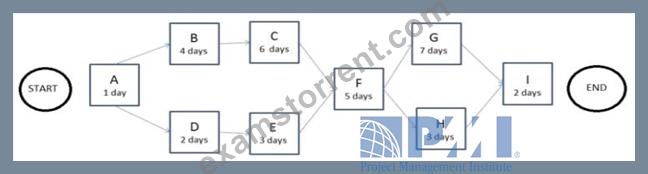
What is the critical path for the project?
- A. A-B-C-F-G-I
- B. A-D-E-F-H-I
- C. A-B-C-F-H-I
- D. A-D-E-F-G-I
Answer: A
NEW QUESTION # 584
Change requests, project management plan updates, project document updates, and organizational process assets updates are all outputs of which project management process?
- A. Plan Risk Responses
- B. Report Performance
- C. Define Scope
- D. Manage Stakeholder Expectations
Answer: D
NEW QUESTION # 585
Conflict should be best addressed in which manner?
- A. Early, in private, using an indirect, cooperative approach
- B. Early, in private, using a direct, collaborative approach
- C. As late as possible, in public, using a direct, confrontational approach
- D. Early, in public, using an indirect, collaborative approach
Answer: B
Explanation:
Section: Volume C
NEW QUESTION # 586
How is the Project Scope Management process different in agile and adaptive projects than in traditional projects?
- A. Project scope management is the same in all projects
- B. More time spent on defining scope early on
- C. Less time spent on scope management process
- D. Less time spent on defining scope early on
Answer: D
NEW QUESTION # 587
While executing a building construction project, the supplier may delay the delivery and increase the cost of materials due to new safety regulations. The team has identified an option to absorb the cost by reducing the lag for some of the tasks.
What should the team do to ensure that this situation is managed?
- A. Perform Quantitative Risk Analysis
- B. Plan Project Risk Management
- C. Perform Qualitative Risk Analysis
- D. Implement Appropriate Response
Answer: D
NEW QUESTION # 588
Changes to formally controlled documentation, plans, etc. to reflect modified or additional ideas or content are known as:
- A. preventive actions.
- B. corrective actions.
- C. defect repairs.
- D. updates.
Answer: D
Explanation:
Section: Volume D
Explanation
Explanation:
4.3.3.3 Change Requests
A change request is a formal proposal to modify any document, deliverable, or baseline. An approved change request will replace the associated document, deliverable, or baseline and may result in an update to other parts of the project management plan. When issues are found while project work is being performed, change requests are submitted, which may modify project policies or procedures, project scope, project cost or budget, project schedule, or project quality. Other change requests cover the needed preventive or corrective actions to forestall negative impact later in the project. Requests for a change can be direct or indirect, externally or internally initiated, and can be optional or legally/contractually mandated, and may include:
Corrective action-An intentional activity that realigns the performance of the project work with the project
management plan;
Preventive action-An intentional activity that ensures the future performance of the project work is aligned
with the project management plan;
Defect repair-An intentional activity to modify a nonconforming product or product component;
Updates-Changes to formally controlled project documents, plans, etc., to reflect modified or additional
ideas or content.
NEW QUESTION # 589
What is the role of project management in terms of organizational strategy?
- A. Project management harmonizes components and controls interdependencies to realize specific benefits
- B. Project management enabled the achievement of organizational goals and objectives
- C. Project management provides the strategic vision for an organization to achieve its goals
- D. Project management aligns initiatives, prioritizes work, and provides resources
Answer: B
NEW QUESTION # 590
A new project has been set. Four main stakeholders besides the project manager and four other team members have been identified.
How many communication channels are available?
- A. 0
- B. 1
- C. 2
- D. 3
Answer: C
NEW QUESTION # 591
The degree, amount, or volume of risk that an organization or individual will withstand is called risk:
- A. tolerance
- B. threshold
- C. management
- D. appetite
Answer: A
Explanation:
Section: Volume B
NEW QUESTION # 592
The processes required to establish the scope of the project, refine the objectives, and define the course of action required to attain the objectives that the project has been undertaken to achieve are grouped within which Process Group?
- A. Monitoring and Controlling
- B. Planning
- C. Initiating
- D. Executing
Answer: B
Explanation:
Section: Volume E
NEW QUESTION # 593
Which of the following is a project constraint?
- A. The technology to be used is cutting-edge.
- B. The product is needed in 250 days.
- C. Project leadership may change due to volatile political environment.
- D. Twenty-five percent staff turnover is expected.
Answer: B
Explanation:
Section: Volume E
NEW QUESTION # 594
Which of the following techniques is used during Control Scope?
- A. Cost-benefit analysis
- B. Variance analysis
- C. Reserve analysis
- D. Stakeholder analysis
Answer: B
Explanation:
Explanation/Reference:
Explanation:
5.6.2.1 Variance Analysis
Variance analysis is a technique for determining the cause and degree of difference between the baseline and actual performance. Project performance measurements are used to assess the magnitude of variation from the original scope baseline. Important aspects of project scope control include determining the cause and degree of variance relative to the scope baseline (Section 5.4.3.1) and deciding whether corrective or preventive action is required.
Process: 5.6 Control Scope
Definition: The process of monitoring the status of the project and product scope and managing changes to the scope baseline.
Key Benefit: The key benefit of this process is that it allows the scope baseline to be maintained throughout the project.
Inputs
1. Project management plan
2. Requirements documentation
3. Requirements traceability matrix
4. Work performance data
5. Organizational process assets
Tools & Techniques
1. Variance analysis
Outputs
1. Work performance information
2. Change requests
3. Project management plan updates
4. Project documents updates
5. Organizational process assets updates
NEW QUESTION # 595
Schedule milestones and a predefined budget are examples of:
- A. Activity cost estimates.
- B. Project constraints.
- C. Organizational process assets.
- D. Requirements documentation.
Answer: B
Explanation:
Section: Volume E
NEW QUESTION # 596
Which process should be conducted from the project inception through completion?
- A. Monitor and Control Risks
- B. Perform Quality Control
- C. Monitor and Control Project Work
- D. Perform Integrated Change Control
Answer: D
NEW QUESTION # 597
Which of the following is a set of interrelated actions and activities performed to achieve a prespecified product, result, or service?
- A. Process
- B. Project
- C. Program
- D. Portfolio
Answer: A
Explanation:
Section: Volume D
NEW QUESTION # 598
Which process determines the correctness of deliverables?
- A. Analyze Deliverables
- B. Review Deliverables
- C. Validate Deliverables
- D. Verify Deliverables
Answer: D
Explanation:
Explanation/Reference:
Reference: https://4squareviews.com/2013/11/22/5th-edition-pmbok-guide-step-6-memorizing-inputs- outputs-quality-management-part-3/
NEW QUESTION # 599
In a project using agile methodology, who may perform the quality control activities?
- A. Selected stakeholders at specific times during the project
- B. All team members throughout the project life cycle
- C. The project manager only
- D. A group of quality experts at specific times during the project
Answer: B
NEW QUESTION # 600
The item that provides more detailed descriptions of the components in the work breakdown structure (WB5) is called a WBS:
- A. register.
- B. report.
- C. dictionary.
- D. chart.
Answer: C
NEW QUESTION # 601
The following is a network diagram for a project.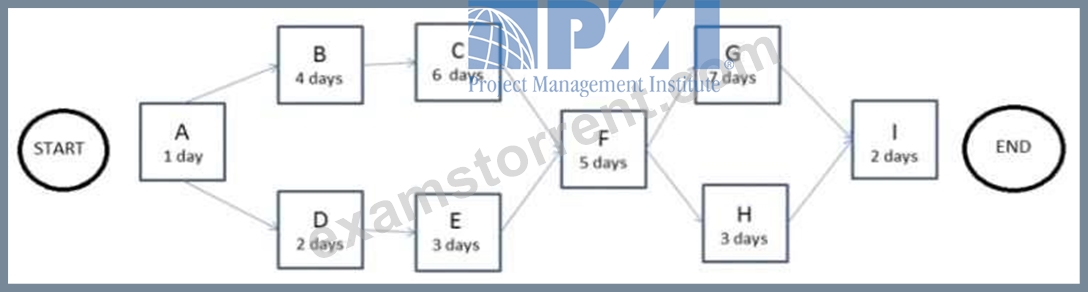
What is the critical path for the project?
- A. A-B-C-F-G-I
- B. A-D-E-F-H-I
- C. A-B-C-F-H-I
- D. A-D-E-F-G-I
Answer: A
Explanation:
Section: Volume B
NEW QUESTION # 602
A collection of projects managed as a group to achieve strategic objectives is referred to as a:
- A. program
- B. process
- C. portfolio
- D. plan
Answer: C
Explanation:
Explanation/Reference:
Explanation:
1.2.1. The Relationships among Portfolios, Programs, and Projects
The relationship among portfolios, programs, and projects is such that a portfolio refers to a collection of projects, programs, subportfolios, and operations managed as a group to achieve strategic objectives. Programs are grouped within a portfolio and are comprised of subprograms, projects, or other work that are managed in a coordinated fashion in support of the portfolio. Individual projects that are either within or outside of a program are still considered part of a portfolio. Although the projects or programs within the portfolio may not necessarily be interdependent or directly related, they are linked to the organization's strategic plan by means of the organization's portfolio.
1.4.2 Portfolio Management
A portfolio refers to projects, programs, subportfolios, and operations managed as a group to achieve strategic objectives. The projects or programs of the portfolio may not necessarily be interdependent or directly related. For example, an infrastructure firm that has the strategic objective of "maximizing the return on its investments" may put together a portfolio that includes a mix of projects in oil and gas, power, water, roads, rail, and airports. From this mix, the firm may choose to manage related projects as one program. All of the power projects may be grouped together as a power program. Similarly, all of the water projects may be grouped together as a water program.
Thus, the power program and the water program become integral components of the enterprise portfolio of the infrastructure firm.
NEW QUESTION # 603
......
LATEST CAPM Exam Practice Material: https://www.examstorrent.com/CAPM-exam-dumps-torrent.html
New CAPM Actual Exam Dumps, PMI Practice Test: https://drive.google.com/open?id=1a17v3I3ujcA7mNGsrXAD7IzEG1HsFkjO